
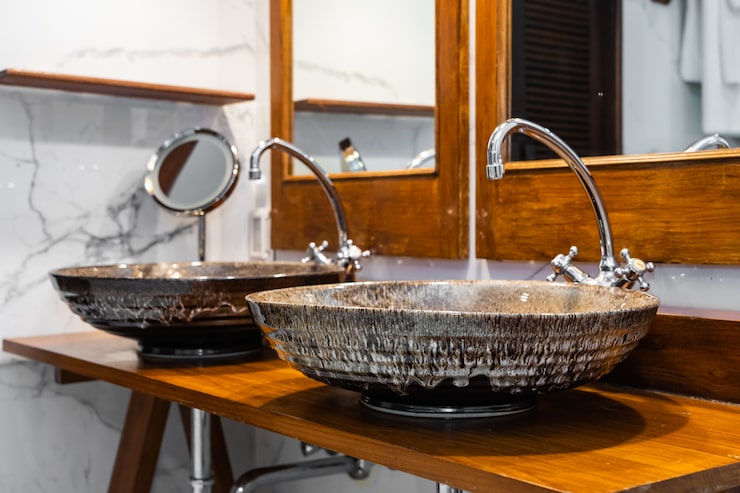

The Fixture That Sets the Tone for the Whole Vanity
A bathroom faucet is a relatively small purchase with a disproportionate visual impact — it’s the fixture at eye level in the bathroom, the one that visitors and users interact with multiple times daily, and the one whose finish and style sets the design direction for everything else at the vanity. A faucet chosen carelessly becomes a design constraint; one chosen deliberately becomes a design foundation.
Faucet selection involves two independent decisions that are often conflated: the functional configuration (which type of faucet fits your sink’s hole configuration and your usage preferences) and the aesthetic decision (which finish and style serves the bathroom’s design direction). Separating these decisions makes each one more manageable.
Configuration Choices: Single-Hole, Centerset, and Widespread
Single-hole faucets use one hole in the sink deck for the spout and handle in one unit. They’re the cleanest, most contemporary option and suit any sink with a single pre-drilled hole. They work in modern and transitional designs and are the easiest to clean — no space between separate handles where mineral deposits accumulate.
Centerset faucets have two handles and a spout on a common base plate spanning three holes at 4-inch centers. This is the most common configuration in residential vanities — the pre-drilled three-hole sink on most production vanities takes a centerset faucet. Widespread faucets have three separate pieces (spout and two handles) for three holes at 8-inch or custom centers, providing the most elegant appearance and the most complex installation. Match configuration to your sink’s existing holes before selecting any faucet.
Finish Durability: What the Coating Actually Means
Faucet finishes are coatings applied to a base metal (usually zinc, brass, or stainless) that determine appearance and durability. Chrome is the most durable finish — a properly applied chrome layer resists water, soap, and cleaning products extremely well and polishes easily. Its limitation is that it shows water spots and fingerprints clearly on polished surfaces.
Brushed nickel hides daily fingerprints and water spots better than polished chrome and has become the standard residential choice for this reason. Matte black is durable when properly coated (look for PVD — Physical Vapor Deposition — coating rather than paint, which chips) and hides spots well but shows water marks and dust. Brass finishes range from lacquered (which maintains the warm gold tone but eventually requires re-lacquering) to unlacquered (which develops a living patina — appropriate for some design aesthetics, wrong for others).
Valve Quality: The Internal Component Most Buyers Ignore
The valve inside a faucet — the mechanism that controls water flow and temperature — determines how long the faucet operates smoothly, how precisely temperature can be controlled, and how the handle feels during use. Ceramic disc valves are the current standard for quality faucets: two ceramic discs that seal against each other when closed, producing a drip-free seal that lasts for the life of the faucet without the washer and seat wear that afflicts traditional compression valves.
The feel of a quality ceramic disc valve — the smooth, precise motion through the temperature range, the positive stop at hot and cold — is immediately distinguishable from a low-quality valve in a brief handle test. This is the most useful in-store evaluation for faucet quality that isn’t visible in any specification sheet.
Flow Rate and Water Efficiency
Bathroom faucets in the U.S. are subject to the federal maximum flow rate of 2.2 gallons per minute (GPM). WaterSense-certified faucets flow at 1.5 GPM or less — a 30% or greater reduction that produces meaningful water savings over the life of the fixture without a noticeable difference in washing performance. In states with active water conservation programs, WaterSense certification may be required for new installations.
The practical implication: when comparing two otherwise equivalent faucets at different prices, verify that both carry WaterSense certification if water conservation is a consideration. The water savings over a 10-year period at 1.5 GPM versus 2.2 GPM are modest at the household level but cumulative at the community level — and the lower-flow faucet typically performs identically for handwashing and face-washing tasks.